The maker of causes

The idea that truth will free us from contradiction owes to our belief in logic as a basis for assessing the facts.  Logic has shown us a universe where up cannot be down, curved cannot be straight, one cannot be two, right cannot be wrong, facts cannot be fictions, after cannot come before etc.

However, more relativistic realisations lead us to understand that things are not necessarily either/ or – that a fact may be both one thing and another: uniform and diverse, clear and fuzzy, fixed and fluid, true and false, explicable and inexplicable – and that there are ways of understanding facts that defy the language by which we try to present our explanations as logically consistent.

Indeed our pride in being logical may actually be a source of ignorance.  For instance, if we are to understand the origins of the universe we may need to rethink the logic of causality, which errs towards the embroidery of our observations of change – as if the nature of the cause explains the nature of possibility, as if the cause equates to the ensuing difference, as if nature and possibility are explicable in terms of things as they were – as if it is the possibility of change that is ‘caused’ when that possibility is, in fact, the maker of causes.  Then, when the gaps in explanation gape and all else fails, we say the cause is chance, as if chance might be sufficient to explain the origin of everything, including the nature of possibility – including the possibility for chance to exist.

Likewise, no ‘cause of life’ has proved sufficient to explain the change that comes about, because whenever the change is attributed to pre-existing causes, it leaves unexplained a difference that cannot be found in things as they were – in the entirety of those unliving causes.

Mike Laidler

Improbable possibilities

It’s a moot point that, despite our technical prowess in ‘getting to know’, a very basic knowledge of ourselves remains sufficient to rival science’s most sophisticated and influential understandings of the nature of existence – not because scientific theories are patently untrue, but because they are not true enough to do justice to a universe that commands a conscious presence.  And whenever we attempt to understand the nature that ‘surrounds us’ we are doing something that is unnatural according to the scientific definition of the nature we are trying to understand.  So when scientists build upon their understandings with rigorous explanations, they introduce a layer of knowledge that is quite unlike the world they are explaining – since it marks a step change amidst a nature that isn’t supposed to know anything.  Indeed, when scientists determine that there is no meaning and purpose in nature, they are making a comparison by way of a criterion that remains larger than the natural causes said to make it all happen – causes that cannot explain for us the change to being conscious.  Thereafter, knowing that knowledge necessarily proceeds knowingly, we can see that an objective reality, unaccompanied by a subjective counterpart, constitutes a lesser fact of ‘a nature’ now redefined by the presence of awareness.


We like to think that our understandings of the world mirror its objective reality, as if the presence of consciousness makes no real difference to the way things are in ‘nature at large’, or in a brain that evolved to ‘think for us’.  On the other hand, the question of whether or not our faculties are just brain processes highlights a point of change of fundamental importance, not just for our understanding of ourselves, but for an understanding of what existence amounts to – and precisely because it is an issue that couldn’t be raised without a subjective point of comparison.  Indeed, only a sentient entity could see that the nature of nature is transformed by a conscious thinking dimension.  It is rather ironic, therefore, that the contribution of our subjective nature gets underrated – as if subjectivity does not sit as a proper fact within an ‘objective’ universe, and consciousness merely subsists in a superfluous world of its own, unable to influence or change the course of events within the ‘true nature of things’.  Yet reality remains bigger than science’s best attempts to know ‘it’ and dominate knowledge by stipulating how ‘the real thing’ should be defined and explained – because the changing possibilities are neither defined by the way ‘things are’, nor explained in retrospect by the way they were.


We struggle to understand the nature of possibility, even as we see it unfolding in a world that ‘makes it all happen’.  Furthermore, logical incongruities plague our attempts to rationalise the interaction between intention, necessity and chance.  Nonetheless, and with great ingenuity, we invent devises to display the workings of chance, but they cannot function independently of their design and intended use.  Also, with eloquence and alacrity, we use words and numbers to affirm our grounding in a ‘definable reality’, but they gain no bearing without our subjective faculty for recognition.  Likewise, there is no knowledge without the capacity for knowing, which we cannot detach from the knower, even though we may devise artificial means of storage and retrieval.  In effect, knowledge introduces a change in reality which feeds back into the course of events and the development of further possibilities within and beyond our immediate purposes.  So things change, including states of awareness, though it is frequently said that ‘we can’t change the world, we can only change ourselves’.  However, by changing ourselves we also change the world – since knowledge transcends the blind facts to open up possibilities in a reality that is no longer characterised by an oblivious inertia.  But first we need to divest ourselves of the false belief that these facts are telling us what to think.


There are numerous examples to remind us that by deferring to ‘the facts as they are’ we are apt to unrealistically discount the importance of change.  Of course we tend not to look to a state of affairs that might be other than we are inclined to see it – that is, until we are confronted by events that rudely defy all expectation to expose disparities in our perceptions of basic matters of fact or the categorical mistakes we make when believing that ‘the truth’ cannot possibly be subject to change.  Consequently, in a world of perceived facts that may not be ‘real’ enough to complete the ‘bigger picture’, the lesson is that the facts aren’t everything until the possibilities have played out, but we can’t assume how the possibilities will play out on the basis of the facts as they are.  Yet that’s just what we do in the name of ‘being realistic’.  So our shared beliefs in ‘the real’ may be the main source of a collective delusion, especially if we live in a universe of multiple realities.  And if we are prone to categorical errors over simple and calculable matters of fact, then how much more might we deceive ourselves about the facts arising within a complex and incalculable universe of possibilities – in a universe that continues to build on change.


Of all things, it takes an American game show to demonstrate how possibilities can change implausibly, even though, as in the world at large, they are actually changing as a result of what we know and decide.  Here’s the nub: Monty Hall hosted a game show that gave contestants the opportunity to win a star prize concealed behind one of three doors.  The lucky contestant chooses – the odds being one in three that they might win.  Then the host opens one of the two remaining doors to reveal a booby prize.  That leaves the star prize behind one of the two unopened doors.  But the odds now shift against the contestant’s choice, which was based on a one-in-three chance, whereas, on the surface, the odds are now clearly 50/50 – although these odds don’t apply automatically in the contestant’s favour.  However, the contestant is given the option of shifting their choice at this point, all against a background of cleverly contrived bribes – because the host knows where the prize is.  On average, contestants gain a better chance of winning by shifting from their original choice, because the odds actually shift, for them, to a massive ⅔ chance of the prize being behind the other door.  However, there followed a fury of angry exchanges between various experts over the possibility of this being so.


The dispute was finally settled using experimental simulations of the outcome, which proved that   the odds do change to ⅔ – whereas, to someone who walks onto the scene ‘cold’, when the choice lies between the two remaining doors, the odds confronting them are strictly 50/50.  Nevertheless, the controversy rolled-on for years in the media, in part because subtle variations in behaviour are sufficient to change the odds, but mainly because the experts couldn’t agree among themselves over the mathematical probabilities – different approaches to the problem seemed to yield different answers.  In addition, their most notable opponent, a gifted woman columnist, was vilified for her stupidity in the face of ‘the facts’.  She had to defend her impeccably correct reasoning against a backlash of ridicule for holding onto her personal opinion in defiance of those who professed to know better by flaunting their professional and academic qualifications.  The stand-off was all the more surreal because the calculation needed to work-out the answer is ridiculously simple, yet it took so long to resolve, and to this day there are dissenters who regard the whole thing as nothing more than a dupe, quirk or distraction of no real consequence.  But what if such ‘quirks’ begin to affect people’s life chances based upon the decisions they are prepared to make, the risks they are prepared to take and the certainties they take to be their guide?


In the bigger picture, it is no longer true to say that reality amounts to no more than the fact of what’s ‘out-there’.  Reality is a dynamic mix of possibilities that interact and change according to what we know and decide, or otherwise ignore.  Possibilities also change on a grander scale, as states of awareness occupy a universe that was previously devoid – the active ingredient at every level, being change.  Further down the line, chance, accident, co-incidence and inevitability in the ‘real world’ become shaped by intentions which were previously absent in ‘nature’.  These intentions are big enough to divert rivers or alter climates – and now there is talk about the possibilities of terra-forming Mars.  Nevertheless, when thinking objectively, things still seen to ‘just happen’ irrespective of what we think – but objectivity does not belong to the world of objects, since it very much a version of thinking made possible by a change that we cannot observe neutrally – so we do not get reality in perspective by perceiving the ‘objective facts’ as the ultimate truth.  Nor is the greater reality compressed, embryonically, inside the lesser – as if it is more realistic to explain things as they were, before the appearance of change.  In the event, a sentient reality introduces a potency of its own – it is a difference that makes a difference.  It means that thought doesn’t exist in the things that don’t think, including all the codes, formulae and algorithms we use as aides to thinking.  This places a responsibility upon us to think about thinking, to be prepared to reflect and doubt, especially when certainty, in a changing world, becomes a restriction that can amount a dangerous delusion.


Thinking commands an exceptional place in nature which the objective facts cannot usurp by ‘telling us what to think’.  In fact, there is something self-contradictory in the expectation that thought and consciousness will one day be identified properly as properties that currently remain hidden within the laws of physics until the facts are uncovered – which raises awkward questions about what uncovers what, what recognises what, and facts hidden from themselves?  Indeed, every so called ‘objective fact’ is actually a perceived fact that comes packaged up with a point of view already attached to it – for in reality, ‘objectivity’ is nothing if it is not a way of thinking.   In other words, we must start with consciousness in order to begin to look for it in the brain, or the laws of physics, where we are bound to find the ‘it’ of it as something else.  Therefore, we need to be ever vigilant and prudent in our considerations of what the ‘objective facts tell us’, especially when eminent thinkers tell us that the facts are telling them what to think.  For instance, here’s some advice on taking risks from a professor of risk, based upon an objective overview of external risk factors: Apparently it’s comparatively less risky for an elderly person to take up sky-diving than it is for a younger person – because, on balance, the older person has to contend with so many additional age-related, often fatal risks, that the particular risks of sky-diving, or swimming with sharks, don’t feature nearly so prominently for them.  But don’t expect to persuade your granny that these ‘hard facts’ can benefit her more than her personal doubts.


Mike Laidler
The Burden of Proof

I   The ‘big bang’ of change

If ‘everything is stardust’ then stardust does more than replenish the universe with lumps; yet even if we could see it all unfold before our eyes, into a living, conscious intelligence, we might gain no more than a cursory overview – courtesy of those somehow ‘enabled’ lumps perceiving themselves – otherwise the stardust isn’t everything.  In fact, we don’t understand these changes, despite all their conspicuous causes.  For instance, the emergent properties of life do not ‘boil down’ to its unliving chemistry – something changes, but it is not germinal to the chemistry, which enables, supports and sustains a difference by remaining as it is.  These dualisms pose problems for proof and explanation that show up in the reasoning we apply to the perception of change – either by identifying a ‘transformative event’ with things as they are, so ‘nothing really changes’, or by differentiating it from things as they were, which taxes logic and leaves the explanation wanting.  In other words, we cannot explain a fundamental change in terms of the properties of a cause without begging the question; and whenever causes are found to diverge, the ‘explanation’ runs into a convolution of uncertain proofs – which is why scientific conclusions are ever prone to error.  Thus no one can prove that order in the universe was caused by ‘the big bang’ or that energy gives definition to form any more than the properties of stardust cause consciousness or the nature of existence comes from the pre-existing nature of its causes.  Indeed, every explanation carries inferences based upon the form of our reasoning in excess of the facts – with the result that facts considered to be self-evident, such as: ‘everything is a part of nature’ and ‘everything has a cause’ lead into explanatory quagmires over ‘the cause of everything’, the necessity of change and the primacy of possibility.  So, if nature is the ‘bedrock of our being’, and everything remains a part of ‘nature’, then our faculties, like everything else, function as natural effects of natural causes, to the extent that nature is now ‘perceiving itself through us’.

II   The ‘little bang’ of chance

Proof begins in the imagination, by imagining that the world is explicable by its causes, as if we can find the nature of one thing in another because an effect is derived from its cause, with the same being true for acquired states of knowledge.  However, such explanations diminish the very fact they purport to explain, namely the fact of change.  Neither do the laws of nature prove that everything has its beginning in the pre-existence of a master cause that provides a blueprint for the universe becoming what it is from what it wasn’t, or otherwise changing from what it was to become more like itself.  Nor can we make the inexplicable explicable by presuming that chance changes the boundaries of possibility when, as a matter of fact, the evidence points to the converse.  Nevertheless, our acknowledgement of a causal continuum serves us well in rationalising our place in existence, as proved by the prerequisites for survival; except that our nature and evolution provide only the semblance of an explanation of the course of change towards an agency that is deliberate intentional and inquisitive – properties that are alien to their ‘primal causes’ in nature as it was.  In fact, all we know is that change introduces new properties – new boundaries of possibility by which we can also see that we differ from our origins in the oblivious morass enough to be threatened by it.  And we can also see that nature is more than a ‘chance engine’ for creating and shaping these possibilities – since chance has no internal mechanism for transcending itself – to become more than itself by chance – whereas ‘nature’ diverges to become a plurality of natures containing meanings, purposes and necessities that stand in stark and inexplicable contrast to things without.  Furthermore, we do not explain change simply by observing it then determining that our observations must explain it if there is nothing else to discern; and no perspective can be big enough to prove the necessity of change by way of the necessities we import into our proofs in order to make them logically tight, and ours.

III   Effects as causes

‘Seeing is believing’ when belief stands in for proof – and the question of proof confronts us once we try to look beyond appearances, to seek the reality behind ‘the seeming’.  Even so, we don’t look to the resolution as amounting to a difference of our making; instead, we experience it as coming through the perception in the same way as we experience perception as coming to us from the world.  Yet there are realities within realities – as when perceived sounds and colours come to transcend their primary causes.  Also, the vast array of our self-conscious perceptions mark a step-change in reality, just as perception marks a step-change from its causes in an oblivious world.  And all the evidence points to the same fact – that our knowledge of the world, even as perceived to be caused by it, is not necessarily the same thing, though we may wish to presume there is no ‘real’ difference for the sake of its validation.  Likewise, we see necessary connections between causes and effects, but it is not the cause that turns first to make the difference real.  That is, the perceived difference ‘arrives’ with the appearance of the effect, there being no change till then, and the fact that the ‘effect’ is as much of a cause in such transitions is known in the event that it becomes a necessity for any further ‘causal changes’ to be perceived, otherwise its existence is superfluous.  Nevertheless, we expect that the change can be explained by identifying it with a preceding cause, as if the cause now belongs in two versions of itself – to be better known in retrospect, for what it ‘really is’ in prospect.  Unfortunately, original causes aren’t amenable to explanation, but undaunted by this, we prefer to perceive the universe, qua existence, as a developed property of an ‘original cause’, as if the possibilities remain defined by this ‘fact’ – thereby proving to ourselves that all subsequent changes are somewhat less than original, and that our perception of everything as a version of stardust goes to show that we are perceiving reality ‘as it is’.

Mike Laidler

The premise of truth

Who can say there is no such thing as truth without professing the truth of the denial?  It may be that we don’t see the contradictions locked into our truth narratives because they are mediated by something much closer to our hearts, something that serves as a subjective antidote to internal conflict and contradiction – belief.  Few people notice the contradictions within their own beliefs, because they believe otherwise.  Indeed, some believe that we now live in a ‘post-truth’ era, which they justify by appealing to the facts seen to verify ‘the truth’ of their claim.  Yet even ‘the plain truth’ is open to conjecture because the naming and telling reflects a subjective outlook striving to show that the facts are speaking for themselves when they are not.   It seems that we have always had a rocky relationship with ‘the truth’, which may be due to the unsettling fact that our objectivity is a state of mind – essentially, a creation of the imagination.

Most of us deal with truths in situ, believing that we obtain our understandings from what is ‘out there’ – from matters of fact that become understandable in terms of what they mean.  However, meanings, understandings and beliefs are facts we put into circulation, and no truth is evident without the accord granted of our recognition.  Likewise, the world is and is not imbued with meaning, only we would rather be at the nurtured end of the nurturing, which is why so much pathos gets attached to the ‘quest for meaning’ or the lament that we can ‘find no meaning to life’.  And we continue to wonder about the truth behind the compelling belief that there is something more ‘out there’ – a belief shrouded in the paradoxical truth that there is no ‘out there’ until there is an ‘in here’.  Hence we might need to explore the question of a wider reality by taking a converse look – to look at what we mean by ‘in here’ in order to ask: is subjectivity a greater or a lesser fact of existence – in the recognisable order of its becoming.

On the whole, belief augments the understanding of things we don’t understand.  Collectively, we exist in a peculiar reality, as a feature of existence trying to understand itself.  Arguably, ‘reality’ is not a fixed state of existence and just as realities change and grow, so can ‘the truth’.  For instance, life did not previously feature in the chemistry that now includes it – so what are we to believe about the nature of life?  What if there is more to reality than the here and now – that everything is in a state of becoming more than it was, including ‘the truth’ – including ourselves?  Perhaps there is more to existence than the ‘external’ facts by which we behold it – because the beholder, unwittingly or not, introduces a new reality of observation into a world that never before observed itself.  So the perception of truth is fraught with the same difficulties as the perception of ourselves – the problem of gaining an inclusive point of view – the problem of understanding the subject by way of the meanings we express through the glimpses we obtain as a part of something bigger than the focus of our attention – even as that focus rests upon ourselves.

Mike Laidler


Is science never right?

Is it true, as said, that ‘science is never right’?† Then is there something that goes beyond the fact of the ‘scientific facts’, calling into question their propriety, which might also call into question scientific findings in fields of study ranging from medicine and psychology to economics and climatology? Does it mean that there is more to knowledge and discovery than science can offer and that our scientific methodologies have their limits? Or does it mean that science is above reproach – because it has already taken account of its fallibilities and has dispensed with belief, especially the dogma of believing totally in itself? Might this allow scientific opinion to form the bedrock of opinion about matters touching upon explanations of fact, including the nature of existence; therefore we can be assured that non-scientific opinions are inferior – for what can those opinions amount to if even the rational sciences can’t profess to being absolutely right – ever? But is it possible that there is more to the universe than its scientific firmament, and who is qualified to say? Who is the impartial questioner of the facts? – not science, if science deems that those questions can be valid only when they are framed scientifically. 

If physicists are ‘never right’‡ then does it mean that governments are being approached to fund scientific projects on false pretexts, with promises of results that cannot be trusted? Does it mean that the famous Higgs boson is not necessarily real just because physicists say it is, or that it may be when they believe otherwise – because the evidence to contradict or redefine their findings is always round the corner? Are scientists claiming that the evidence tells them what to think, when it is their thinking that directs their attention to ‘the evidence’ and its selection? How important is the weight of evidence if it stands to be overturned by facts that hitherto weighed lightly in the minds of scientists? Perhaps explanation is but a technical way of expressing theories loaded with meanings that cannot be finalised – meanwhile discovery involves something more than a factual retrieval exercise. Perhaps it means that the real world is bigger than science and that science remains as it was at the outset – a methodological philosophy of nature. Perhaps ‘nature’, so called, amounts to a theory about something that is bigger than our grandest ideas about what it is – including the idea that it is a thing in existence definable by advantage of its observation.
Mike Laidler

† Interview with the scientist Brian Cox on BBC Radio 4 Today Programme, 16 June 2016. (Vide: ‘The science paradox’.)
‡ Per Professor Brian Cox speaking on ‘Start the Week’, BBC Radio 4, 19 December 2016. 

To be a Philosopher

What is philosophy?  The answer lies in the question itself, because philosophy is all about asking questions.  Philosophy is not in the business of dictating answers, so an appropriate philosophical non-answer to the question is that philosophy examines the foundations on which we can claim to know anything.  Not surprisingly, this philosophical position challenges the credibility of all those who profess to know, and philosophy gains a well-deserved reputation for effrontery when it pitches the wisdom of not knowing against the authority of those who claim to know better.  The rest is history, but as philosophers we remain interested in what comes next, knowing that one of the obstacles to ‘getting to know’ is the belief that we know already.   This issue raises the philosophical paradox of knowing that we don’t know, which sits at the heart of knowledge like a ‘black hole’ sitting at the heart of the universe, apparently gobbling up its substance.  But perhaps the ‘dark matter’ of paradox is the gateway to another universe of understanding – beyond the confines of certainty.

A ‘certain fact’ is more a reflection of our psychology than the nature of an external world, for there is no fact in mind that has not been elevated to prominence by our selective thinking.  So our certainties may amount to no more than psychological inflexibilities concerning ideas we want to uphold, or myths we don’t want to relinquish.  Such is the case with our ideas of causality and nature as the cause of existence.  Meanwhile, our ideas about the special nature of life remain unshaken by all the explanations reducing it to unliving processes.  And though we might deem to explain consciousness as an outgrowth of unconscious functions, we know that much only because we already know consciousness to be something much more than that. Nonetheless, the facts continue to inform and it is tempting to think that they are selecting and refining our explanations and conclusions – that the ‘weight of evidence’ will eventually iron out any anomalies and contradictions.  But what if the facts are not straightforward in themselves?  What if the cumulative factual data remains inherently contradictory?

Despite knowing that life is made of some cheap chemicals that become organised, we still don’t know what makes the difference that makes them ‘come to life’ – knowing, as we do, that life marks a difference we cannot ignore by claiming there is no real difference.  Likewise, there are some important questions we can ask only ourselves, such as: by what property of thought are we able to think that a thought is just a brain process and in what state of knowledge do we conclude that it can’t be anything else?  Then what if facts are no more than markers of changes that can’t be explained adequately in terms of things as they were?  What if nature is a plurality of natures to be understood not as one thing or another, but as one thing and another?   In other words, there may be more to reality than the objective facts can reveal about a natural reality that has no cause to think about itself.

What is the law of nature that says everything is really something else or that knowledge owes to this form of explanation?  Perhaps we need to acknowledge the limits of explanation and look to the knowledge that comes with a re-awakening to ourselves as subjective entities, with subjectivity serving as a prerequisite to knowing anything.  Even in science we like to show that we know we know, but to truly know is to realise its limits – back to the paradox!  Then what can we know?  We know that knowledge is impossible without a reference to the facts, but it would be a big mistake to conclude that the facts are the drivers of knowing and wholesale repositories of certainty.  And whereas it seems quite logical to think that more and more facts are the answer to our factual conundrums and theoretical shortcomings, it is wholly unreasonable to think that the facts draw their own conclusions and can explain for us the nature of thought, reason, consciousness and understanding, as if there is nothing more to knowledge than a body of fact, and more to the better when it belongs to an objective state of reality that remains inherently unknowing – as if there is nothing more to reality, or for that matter, being realistic.

Mike Laidler

Dialectical diversions

Our understandings lay claim to the facts on the understanding that those facts can be characterised by their consistency – inferring that even as things can be seen to change over time, the nature of that change forms a pattern of consistencies underpinned by a natural lawfulness and immutable truth. However, it is our conceptualisations of fact, rather than the facts themselves, that require ‘their truth’ to be free of contradiction. Meanwhile, the everyday is replete with factual contradictions that we purposely overlook in favour of a perceived logical integrity – a logic we claim to inherit from a nature that apparently has no purpose in it. Likewise, life is seen to be a derivative of an unliving nature that is both changed and unchanged – a contradiction that remains embedded in the very stuff of our DNA, understood as the unliving stuff of life. Furthermore, quantum mechanics reveals that our world is built upon, indeed depends upon, a raft of stark factual anomalies.

Normally, we habilitate the factual contradictions by making them inter-personal – by supplementing our observations with theories and opinions by which we variously agree or disagree with one another. And the more we expect the truth to be either one thing or the other, the more those perspectives tend to polarise. So the paradoxes holding truths in contradiction get assimilated as factors of ideas in opposition. Then, by rationalising different points of view, we move to mould the facts and ideas into an intellectual consistency, albeit hypothetical – as if, from a synthesis of our contentions and disputations, truth might emerge to resolve contradiction and uphold our reasoning. Thereby we affirm, in applying that synthesis to our observations of reality, that the facts show us truths that cannot be inconsistent – one thing and another – lest we abandon sound reason in countenancing a nature that can be both mindless and aware, or an earth beneath our feet that is both round and flat.

Mike Laidler

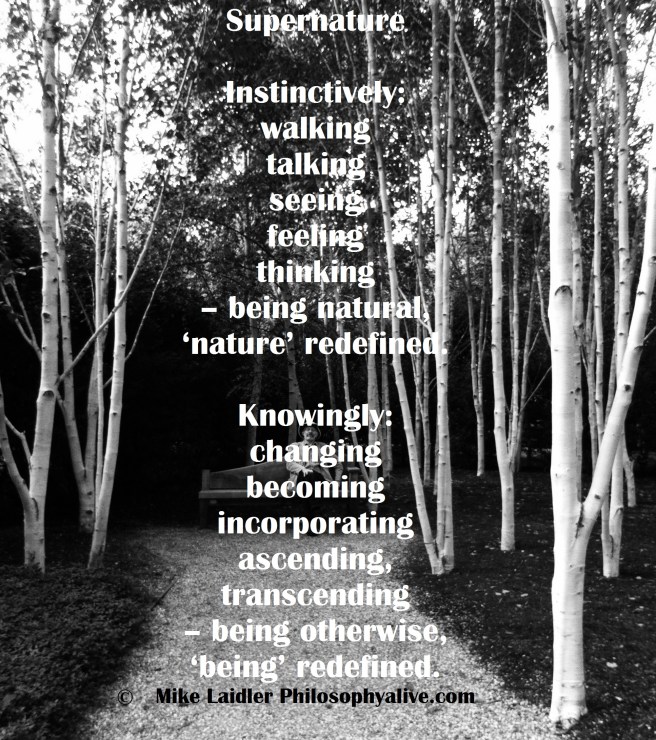
Supernature

Instinctively:

walking

talking

seeing

feeling

thinking

– being natural,

‘nature’ redefined.


Knowingly:

changing

becoming

incorporating

ascending,

transcending

– being otherwise,

‘being’ redefined.

©Mike Laidler